LAOLA - Interactive therapy support using AI-based mouth, posture and speech recognition, using the example of voice disorder therapy: Motion Analysis & Decision Support
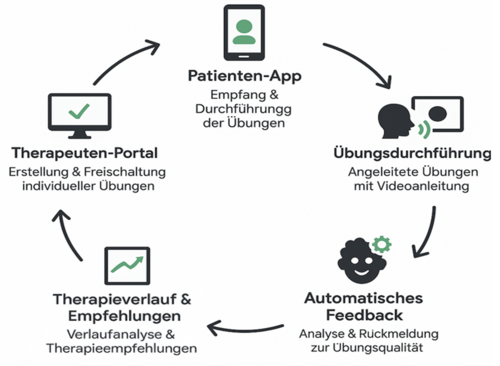
The LAOLA project is developing an app that enables patients to carry out speech and language therapy exercises flexibly from home. Regular and correct practice is crucial to the success of voice therapy. At the same time, staff shortages, the growing demand for flexible forms of therapy and demographic change are posing major challenges for the healthcare system. Digital solutions such as LAOLA can help to complement therapeutic services effectively.
The app offers guided exercise videos, a voice diary and detailed exercise logs. The exercises are assessed in terms of both visual aspects (analysis of mouth movements, body movements and posture correction) and auditory aspects (voice analysis). On this basis, after completing an exercise session, patients receive automated feedback in the form of a score assessing the quality of their performance. This helps them to improve their exercises in a targeted manner and to document their progress in a transparent way.
In addition to the app, a web platform is available for therapists. This allows them to unlock individually tailored exercise sessions and monitor the course of therapy. Therapists also receive the score assessment, which is made available to patients as well. Furthermore, they receive recommendations for exercise sessions that are suitable for the further course of therapy, based on previous results.
The University of Lübeck’s role in the LAOLA project is to develop methods for the visual analysis of mouth movements and body postures (based, amongst other things, on joint point analysis) and to devise concepts for automated decision support in the planning of therapy. To this end, methods such as image processing and machine learning are utilised. The aim is to provide well-founded feedback on the performance of exercises and thereby support patients and therapists in planning and carrying out the course of therapy.
As part of the project, a user survey on the requirements for the app has already been carried out, and two scientific studies have been initiated to evaluate the app and the exercise and feedback concepts it employs.
Further information on the project and the partners involved can be found on the project website.
Available thesis topics
If you would like to undertake your work placement or write your final-year dissertation as part of this project, please feel free to take a look at our available dissertation topics here. The relevant topics are marked with the abbreviation LA.
Project funding / Cooperations
The joint project is funded by the BMBF for the period 2022 - 2025.
Publications